AI diagnosis & failure clustering
When a run finishes, Piwi groups related failures and — optionally — asks an LLM to explain them. The two features work together: clustering decides what to diagnose, AI diagnosis explains why it broke.
Failure clustering
Failed test cases that share the same error fingerprint are grouped into a cluster automatically. Instead of scrolling through 20 unrelated stack traces, you see something like "20 failures, 3 root causes."
- Fingerprinting normalizes error messages so that the same underlying failure groups together across tests, spec files, and runs. Volatile fragments are masked out: timeouts and other numbers, UUIDs and hashes, URLs and emails, and both the expected and received values of an assertion. Dynamic locator options (e.g. the
{ name: '…' }of a table row) are masked too, so per-row failures collapse into one cluster — while the locator target itself (the test id / role) still distinguishes genuinely different failures. - Fingerprints are call-site agnostic: the failing stack frame is shown for context but doesn't split clusters, so one root cause reached from several spec files stays a single cluster.
- The run detail page shows each failure group with flaky and worker-correlation heuristics, so you can tell "the app is broken" from "worker 3 is misbehaving."
- Every cluster has its own detail page with the affected tests, triage tools (status + notes), and the AI diagnosis panel.
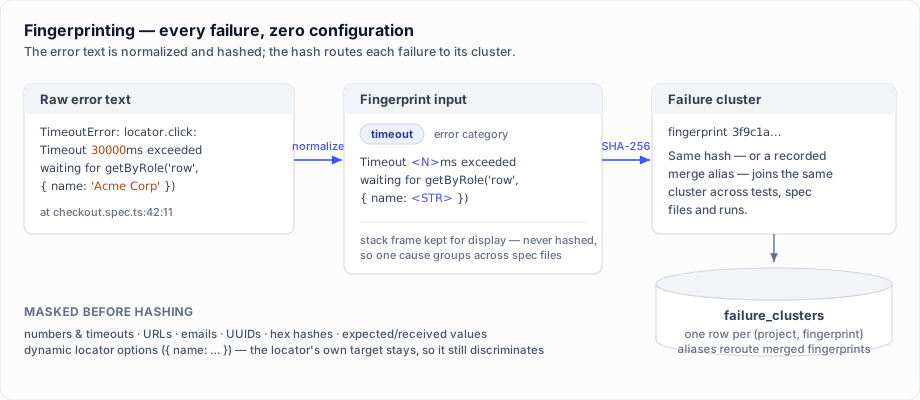

Clustering is always on and requires no configuration. When the normalization algorithm is improved, existing clusters are migrated in place (re-fingerprinted from a stored sample error), so triage status, notes, and diagnoses survive the change. AI diagnosis is opt-in.
Semantic merging (optional)
If an embedding model role is configured (Settings → AI), Piwi adds a semantic layer on top of the deterministic fingerprint. After a run, the clusters first seen in it are embedded and compared (cosine similarity) against the project's other open clusters; near-duplicates above PIWI_CLUSTER_SIMILARITY_THRESHOLD (default 0.92) are merged into the longest-lived cluster. This catches failures that are the same root cause but phrased differently enough to dodge the fingerprint. Merges record a fingerprint alias so future occurrences attach to the survivor instead of re-forking. With no embedding role configured, clustering stays purely deterministic.
The text fed to the embedder is cleaned first — ANSI color codes stripped, framework stack frames collapsed, and volatile tokens (URLs, ids, received/expected values) masked — so vectors measure a failure's shape rather than its per-occurrence noise. Each pass also backfills a bounded batch of older open clusters that don't have a usable vector yet (created before the embedding role existed, or embedded with a different model), so a pre-existing backlog of near-duplicates converges over the runs that follow. Vectors are only ever compared within one embedding model: after switching models, stale vectors are re-embedded by the same backfill instead of being scored against the new model's output.
When auto-diagnose is enabled, new clusters are also given a short human-readable title (one cheap batched model call per run, using the research model when one is configured, otherwise the diagnosis model) shown in place of the raw normalized signature across the lists and the cluster page — the signature stays available on hover and below the title. Clusters fall back to the signature when no title has been generated.
Pairs that fall in the ambiguous band (similarity between PIWI_CLUSTER_SUGGEST_THRESHOLD, default 0.80, and the merge threshold) aren't merged automatically. Whenever AI is configured, a model adjudicates the pair ("same root cause?") — the research model when one is configured, the diagnosis model otherwise — and merges only on a high-confidence yes; when it's unsure (or no AI is configured at all), the pair becomes a merge suggestion on the project's Failure clusters tab, where a reporter or admin approves (merge) or dismisses it. The adjudicator sees more than the error text: each cluster's extracted locator, its most-affected tests, and how much the two clusters overlap (tests failing in both, runs where both fired) — signals that separate "one cause, reworded message" from "similar boilerplate, different problems". Adjudication is budget-capped per run to control cost.
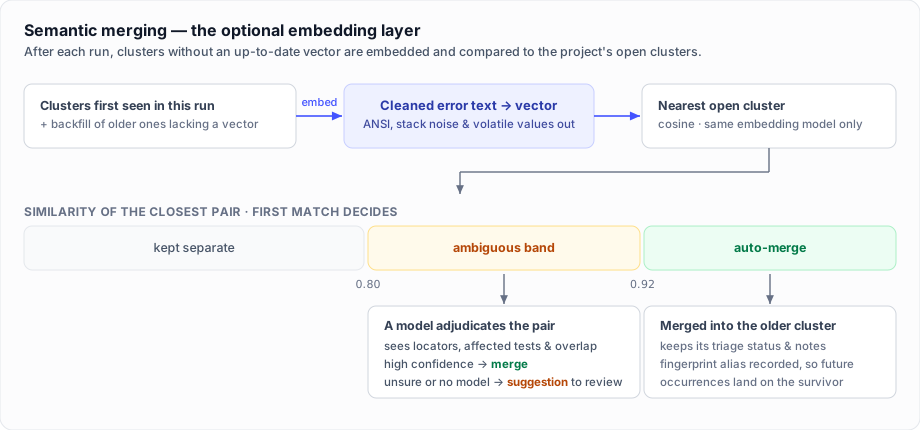
PIWI_CLUSTER_SUGGEST_THRESHOLD and PIWI_CLUSTER_SIMILARITY_THRESHOLD defaults.Embedding-based reconciliation runs after every finished run whenever an embedding role is configured — it is independent of the auto-diagnose toggle.
Did the fix work?
A cluster used to go quiet and stay open forever — nothing ever confirmed it was actually fixed. Now every full run answers that.
When a run executes every test a cluster covers and they all pass, Piwi records the fix: the run, the commit, and how long the cluster was open. Three verdicts, because they are not the same claim:
| Verdict | Means |
|---|---|
| Stopped failing | The tests pass again. A flaky test can achieve this by accident. |
| Diagnosis verified | The commits since the last failing run touched a file the suggested patch named — the change Piwi pointed at is the change that fixed it. |
| Regressed | A fix was recorded, and the cluster is failing again. A fix that didn't hold is worth knowing about. |
The verdict appears on the cluster page, under the signature, with the run the fix landed in, the commit, and how long the cluster stayed open. The project's Failure clusters tab shows it beside the triage status — deliberately as a second badge rather than folded into the first, because the two answer different questions: the status is what a person declared, the verdict is what the runs showed. A cluster somebody marked resolved that is quietly failing again shows both, and that disagreement is the point.
Two rules keep the verdict honest:
- Partial runs are ignored. A test that didn't execute hasn't been shown to pass, so a
--grep-filtered run never closes a cluster. - Every affected test must pass, not just some — a cluster is one root cause, and half of it passing means it isn't fixed.
When pull-request feedback is on, the comment gains a Fixed by this change section naming what the pull request closed. That section is worth a comment on its own, so a green run that closed a cluster still gets one even with only comment on failures set.
Enabling AI diagnosis
Configure a provider via Settings → AI, or with environment variables (env always takes precedence over values stored through the UI, and the UI shows env-managed fields read-only).
| Variable | Description |
|---|---|
PIWI_AI_PROVIDER | anthropic or openai |
PIWI_AI_API_KEY | Provider API key (stored encrypted when set via the UI; never returned by the API) |
PIWI_AI_MODEL | Model name (default: claude-opus-4-8 for Anthropic) |
PIWI_AI_BASE_URL | Base URL for OpenAI-compatible providers (e.g. Ollama, LM Studio, vLLM) |
PIWI_AI_AUTO_DIAGNOSE | true to automatically diagnose new clusters when a run finishes |
PIWI_AI_AUTO_DIAGNOSE_MAX | Max clusters auto-diagnosed per finished run (budget cap; default 3) |
PIWI_AI_RESEARCH_MODEL / _PROVIDER / _BASE_URL / _API_KEY | Optional research model for two-stage diagnosis; provider/base URL/key default to the main ones |
PIWI_AI_EMBEDDING_PROVIDER / _MODEL / _BASE_URL / _API_KEY | Optional embedding model for semantic failure clustering (OpenAI-compatible only — Anthropic has no embeddings API) |
GET /api/ai/status reports whether AI is configured (without ever exposing the key); the UI uses it to show or hide AI actions.
Streaming diagnosis
Instead of waiting for a synchronous response, the diagnosis can be streamed via SSE (Server-Sent Events) — the model's reasoning tokens appear in the UI as they arrive:
POST /api/failure-clusters/[id]/diagnose/stream— same request body as the synchronous endpoint, but the response is atext/event-streamwithevent: thinkingchunks containing incremental text, then a finalevent: resultwith the complete diagnosis.- The client uses
fetch()withPOST(notEventSource) so it can send request body params (additional context, images, base commit, etc.). The response body is read as aReadableStreamand parsed for SSE messages. - See the API docs for the exact protocol (the in-app API reference at
/docsshows the same spec). - In the UI, the live thinking panel shows the accumulating text with a stage indicator and auto-scroll. When the stream completes, the panel transitions to the full result card.
Model roles
Piwi calls models in up to three distinct roles, each with its own complete provider configuration (or a reuse pointer to inherit another role's provider and credentials):
- Diagnosis — the main model that writes the final diagnosis (required to enable AI).
- Research — an optional cheaper/faster model that pre-analyzes the failure first (two-stage diagnosis).
- Embedding — an optional embeddings model that powers semantic failure clustering.
Configure each role in Settings → AI → Model providers. A role set to reuse another role uses that role's provider, key, and base URL — only its model can differ — so you don't re-enter credentials for, say, a Haiku research pass on the same Anthropic key.
Providers
Anthropic (recommended)
PIWI_AI_PROVIDER=anthropic
PIWI_AI_API_KEY=sk-ant-...
PIWI_AI_MODEL=claude-opus-4-8
OpenAI
PIWI_AI_PROVIDER=openai
PIWI_AI_API_KEY=sk-...
PIWI_AI_MODEL=gpt-4o
OpenAI-compatible / local (Ollama, etc.) — set provider to openai and point base URL at the local endpoint:
PIWI_AI_PROVIDER=openai
PIWI_AI_BASE_URL=http://localhost:11434/v1
PIWI_AI_MODEL=llama3.1
PIWI_AI_API_KEY=ollama   # any non-empty value for local servers
Use Settings → AI → Test to smoke-test the configured provider.
What a diagnosis contains
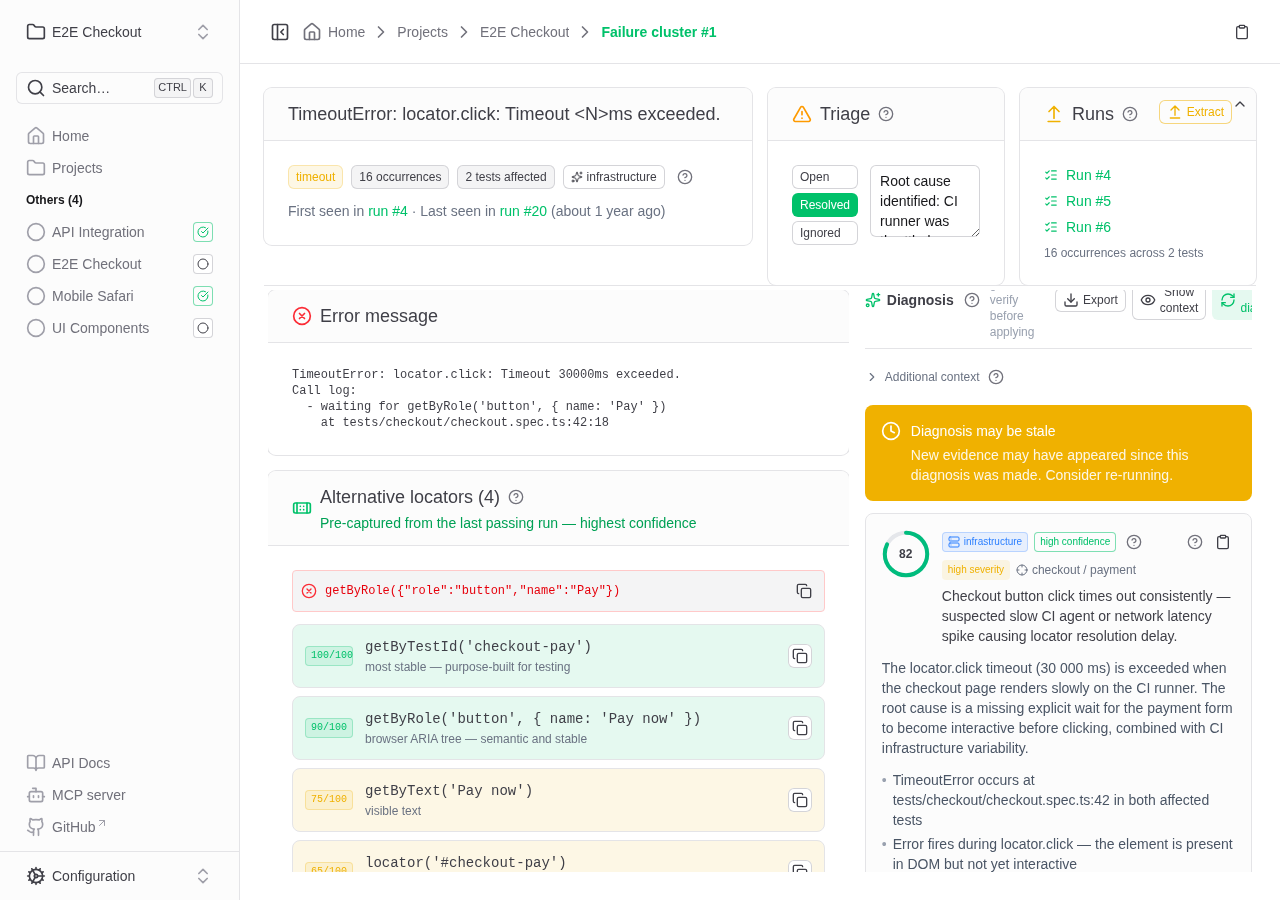
A diagnosis is grounded in your actual run — it is not a generic "ask AI" button. Each result includes:
- Category and confidence
- Root cause — the most likely explanation
- Evidence — the signals the model relied on
- Suggested fix and prevention tips
Diagnosing one execution
The failure cluster page diagnoses a group of failures that share a fingerprint. When you are looking at a single failing execution, the test case detail page's Diagnosis tab can diagnose just that execution — same model, same structured result, scoped to the one run in front of you. This is handy when a failure hasn't clustered yet, or when you want a diagnosis grounded in this specific execution's evidence rather than the cluster aggregate.
Two things are always available there, even with no provider configured:
- Copy AI context — copies the exact evidence bundle (error, steps, console, network, ARIA snapshot, source — plus, when a trace was uploaded, the full call stack with embedded source and the trace's complete network activity — all trimmed to the context limits) so you can paste it into your own AI tool. It is the same context the model would receive.
- A coverage strip showing which evidence sections are present, truncated, or absent — the same map the model sees.
With a provider configured, Diagnose with AI runs the diagnosis inline and renders the result (category, confidence, root cause, evidence, suggested fix) right in the tab; cited evidence links jump to the matching section on the page. The result is stored per execution, so it survives a reload, and you can add free-text context or re-diagnose. Execution-scoped and cluster-scoped diagnoses are independent — running one never overwrites the other.
SCM-grounded context
The real power is feeding the model the code that changed. On a cluster page you can:
- Pin a baseline commit — the diagnosis includes the aggregate diff between that commit and the run, so the model sees what changed.
- Browse and cherry-pick commits — add the full diff of specific commits to the context for targeted analysis.
- Preview the exact context that will be sent before running (
GET /api/failure-clusters/[id]/context), so there are no surprises about what leaves your server.
Commit selection algorithm
When you trigger a diagnosis, Piwi determines the commit range to diff using the following priority chain:
Manual override — if you pinned a baseline commit (or the cluster has a
manualBaseCommitsaved), that commit is used asfromSha. This applies even in auto-diagnose and MCP-triggered diagnoses. TheData Coverageblock in the AI context will showbaselineKind: manual.Project-wide last-green run — Piwi looks for the most recent test run (for the same project) that finished with
status = 'passed'before the first run in which this cluster appeared (firstSeenRunId, notlastSeenRunId). UsingfirstSeenRunIdgives the tightest possible causal window: the diff covers exactly the commits introduced between when the suite was last fully-green and when the failure was first observed.baselineKind: run-green.Per-test last-passing fallback — if no project-wide green run exists (e.g. the project is new, or CI has been failing for a long time), Piwi falls back to the last run where this specific test case passed. This is less precise than a project-green baseline but still vastly better than no diff.
baselineKind: test-green.No SCM data — if none of the above yields both a baseline commit and a current commit (from the run's SCM metadata), no diff is fetched. The
Data Coverageblock marksscmInvestigationabsent and explains why (missing repository URL, no SCM token, or a fetch error).
The coverage.scm.baselineKind field is available on every diagnosis response and in the context-preview endpoint, so you can always tell which path was taken. If an SCM fetch fails, coverage.scm.error contains the first 300 characters of the error message.
Relevance scoring
Changed files are ranked by relevance to the failing test before patch text is included in the context (the patch budget is limited). The scoring signals are:
| Signal | Score |
|---|---|
| Patch removes a line containing a string the test was trying to locate (smoking gun) | +8 |
| Patch touches (but doesn't remove) a locator-literal string | +6 |
| Test imports this file (basename match) | +5 |
| Changed file IS the test file | +4 |
| Changed file shares the test file's basename | +2 |
| Filename token overlaps with the test title or page ARIA state | +1 each |
File is under a source directory (src/, lib/, app/, …) | +1 |
| File is a lockfile, doc, or config | −1 |
Files scoring ≤ 2 are excluded from the "Top Suspected Change" callout (a low-signal hint is worse than none), but they still appear in the full changed-files list.
Full source files
A diff shows only the lines that changed. To write a patch the model needs the surrounding code too, so — when SCM is reachable — Piwi also fetches the full current content of the most-suspect changed files (top-ranked by the relevance score above) and the failing test's local imports (page objects, helpers, fixtures resolved one hop from the test's import statements), at the commit under test. These land in a Source Files context section with NNNN | line numbers so the model can compute correct hunk headers.
Capped by PIWI_AI_MAX_SOURCE_FILES (default 4, set to 0 to disable) and PIWI_AI_MAX_SOURCE_FILE_CHARS (default 12000). Fetched over the same SCM provider API as the diff (GitHub/GitLab/Bitbucket), cached per commit SHA. The coverage.sourceFiles field on the context/diagnosis response lists which files were pulled in.
Validated patches
Every suggestedFix.patch is checked server-side, before it reaches you, against the exact source files the model was shown: Piwi parses the unified diff and dry-runs each hunk against the real file content (tolerating line-offset drift). The result is stored on the diagnosis as details.patchValidation.status and shown as a badge on the patch:
| Status | Badge | Meaning |
|---|---|---|
applies | ✅ Applies cleanly | Every hunk matched at its stated position |
applies-with-offset | ⚠️ Applies with offset | Matched, but at a shifted line — git apply should still succeed |
stale-file | ❌ Does not apply | The file diverged from what the patch expects |
invalid | ❌ Invalid diff | The text isn't a parseable unified diff |
unchecked | Unverified | The target file wasn't in context, so the patch couldn't be validated |
A wrong patch is worse than none, so the model is instructed to set patch to null unless it can quote the lines it changes from the Source Files / Test Source sections. The patch card offers Copy, Copy git apply command, and Download .patch; applying is always manual (the dashboard never writes to your repository).
Locator healing
When the failure is a broken locator, the context includes an Alternative Locators section: ranked replacement locators sourced from a prior passing run (highest confidence — captured against the real DOM), from a fresh match of the renamed/moved element on the failing page, or from the failure-time ARIA snapshot. The section also names a single recommended fix — convention-preserving where the original locator style is stable enough — which the model is instructed to use verbatim in suggestedFix.code rather than fabricating a locator. When nothing scores as stable, it advises adding a data-testid to the application as the durable fix.
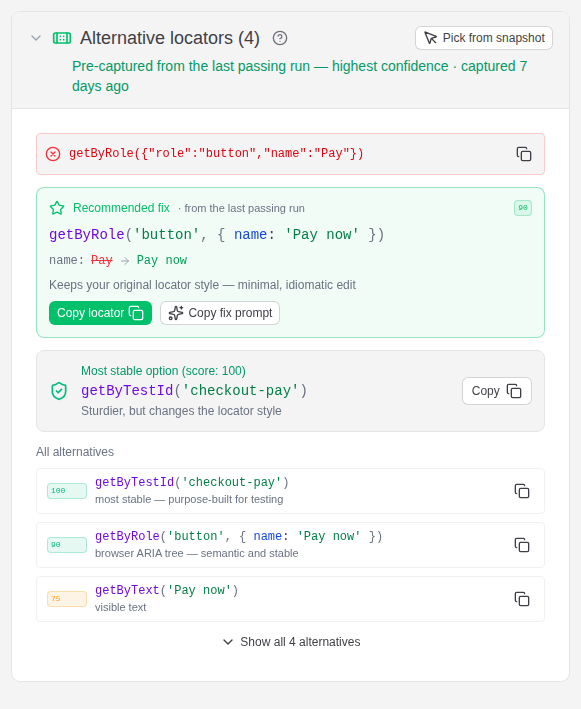
This evidence is generated from the locator snapshots recorded by the capture fixtures while tests run — make sure your specs import test from a fixtures file that extends piwiFixtures. Capture is gated by the default-on captureLocators reporter option. The same data drives the standalone Alternative locators panel on the test-case and cluster pages.
Fix plans for coding agents
Everything above is assembled into one answer at GET /api/failure-clusters/:id/fix-plan, and as the get_fix_planMCP tool: the diagnosis and its validated patch, the ranked locator replacement with the exact file and line to edit, the failing tests, the owning team, and the command that verifies the work.
The last part is what makes it a loop rather than a lookup. The plan states which Playwright command runs exactly the affected tests, and that Piwi will record the fix once they pass — so an agent can confirm its own work instead of leaving a human to decide whether it landed.
Every section degrades on its own. A cluster with no AI diagnosis still returns its failing tests, its locator suggestions and its verification command, so the plan is useful without an AI provider configured at all.
Worth stating plainly: none of this leaves your machine. The dashboard is yours, the model is whichever one you configured (including a local one), and the patch was validated against your own source before you saw it.
Custom instructions
Tailor the analysis to your stack with global instructions (Settings → AI) and per-project instructions. Use them to describe your architecture, common false positives, or house style for fixes.
Context limits (and token cost)
Every piece of evidence sent to the model costs tokens. Piwi caps each input so diagnoses stay fast and affordable. Defaults live in shared/ai-context-limits.ts; override them in Settings → AI or via env (env wins; the UI then shows the field read-only).
The full list of PIWI_AI_MAX_* limit variables, their defaults and their clamping ranges lives in the Configuration reference → AI context limits — generated from the same registry the server reads, so it can never drift from the code.
Screenshots are the one input a provider can refuse outright: many self-hosted and gateway models are text-only and reject a request that carries images. Piwi retries that call without them, so the diagnosis still runs on the text evidence. Setting PIWI_AI_MAX_IMAGES=0 skips the rejected first attempt.
Try it in the demo
The live demo runs entirely in your browser with no AI provider — yet the diagnosis experience is fully wired. Several failing clusters ship with a completed diagnosis (category, confidence, evidence with citations, a validated suggested patch, per-stage pipeline stats, and auto-selected suspect commits); others are left undiagnosed so you can trigger a simulated streaming diagnosis yourself and watch the reasoning tokens arrive. The diagnoses are generated from each cluster's real seeded evidence (occurrences, failure rate, affected tests, browsers) and a canned SCM history, so the Context sent to AI modal, the data-coverage map, the commit browser, baseline pinning, and the diagnosis version history all behave as they do against a real server. Suggested-fix patches are validated against the seeded source files, so the "Applies cleanly" badge means the same thing it does in production.
The demo also carries three clusters with a recorded resolution, one per verdict — including one marked resolved by a person that the runs show failing again, so the difference between what somebody declared and what actually happened is visible without waiting for it to occur.
Privacy
API keys are encrypted at rest with PIWI_SECRET_KEY. When you run a diagnosis, the bounded context above is sent to your configured provider — so for fully local analysis, use Ollama or another self-hosted OpenAI-compatible model and keep everything on your own infrastructure.
See also
- Core concepts — fingerprints, clusters, and baselines in one place
- Privacy & data flow — exactly what a diagnosis sends, and where
- Configuration reference — all environment variables
- Notifications — subscribe to
cluster.newanddiagnosis.completedto get alerted when a new cluster appears or a diagnosis completes (browser, email, Slack, or webhook) - MCP server — let AI agents query clusters and diagnoses directly